
Ser vs Estar: The Complete Guide With Chart and Examples
 LingQ
12 Jul 2024
LingQ
12 Jul 2024
Updated June 2026
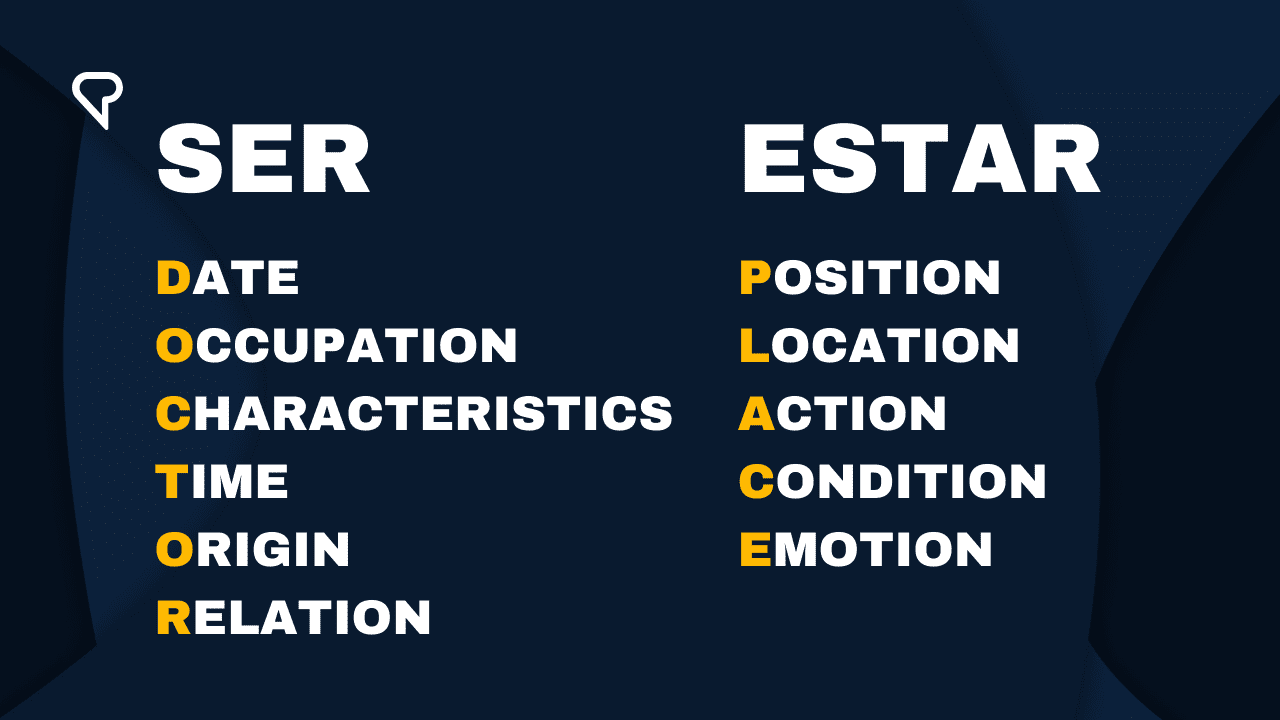
TL;DR: Spanish has two verbs that both mean “to be”: ser and estar. Use ser for permanent or defining qualities (identity, origin, relationships, time). Use estar for temporary states (emotions, location, conditions, ongoing actions). The DOCTOR and PLACE acronyms help you remember which is which, but a handful of exceptions are worth knowing before you encounter them in the wild.
Out of all the challenges in Spanish, ser vs estar trips up more learners for longer than almost anything else. In English, one word covers everything: “to be.” In Spanish, that single concept splits into two separate verbs with distinct rules, and getting them mixed up changes the meaning of what you’re saying in ways that can confuse or even amuse native speakers.
This guide walks you through everything you need: a clear chart, the DOCTOR and PLACE rules with examples, the exceptions that most guides skip, and how to move from knowing the rules to using both verbs naturally.
What Do Ser and Estar Mean?
Both ser and estar translate to “to be” in English, but they are not interchangeable. Ser describes what something fundamentally is: its identity, nature, and defining characteristics. Estar describes how something is at a given moment: its current state, position, or condition.
Think of it this way: if you can imagine the quality imminently changing, use estar. If it defines the person or thing at a fundamental level, use ser.
Ser vs Estar: Quick Comparison Chart
| Ser | Estar | |
|---|---|---|
| Type of quality | Permanent or defining | Temporary or changeable |
| Acronym | D.O.C.T.O.R. | P.L.A.C.E. |
| Used for | Identity, origin, time, relationships, occupation, characteristics | Position, location, actions, conditions, emotions |
| Example | Soy estudiante. (I am a student.) | Estoy cansado. (I am tired.) |
| Example | Ella es alta. (She is tall.) | Ella está enferma. (She is sick.) |
| Example | Hoy es lunes. (Today is Monday.) | Estamos en Madrid. (We are in Madrid.) |
Ser and Estar Conjugations
Before diving into the rules, here are the present tense conjugations for both verbs. Both are irregular and must be memorised.
Ser Conjugation (Present Tense)
| Pronoun | Ser | English |
|---|---|---|
| yo | soy | I am |
| tú | eres | you are |
| él / ella / usted | es | he / she / you (formal) is |
| nosotros | somos | we are |
| vosotros | sois | you all are (Spain) |
| ellos / ellas / ustedes | son | they / you all are |
Estar Conjugation (Present Tense)
| Pronoun | Estar | English |
|---|---|---|
| yo | estoy | I am |
| tú | estás | you are |
| él / ella / usted | está | he / she / you (formal) is |
| nosotros | estamos | we are |
| vosotros | estáis | you all are (Spain) |
| ellos / ellas / ustedes | están | they / you all are |
Note: estar is more regular in its endings (-oy, -ás, -á, -amos, -áis, -án), but neither verb follows the standard patterns. Both need to be learned as fixed forms.
When to Use Ser vs Estar: The Quick Rule
The most reliable shortcut for distinguishing between ser and estar: if the quality is part of who or what something fundamentally is, use ser. If the quality describes a state that could change, use estar. A person is tall (ser). A person is tired (estar). Tallness is defining; tiredness is temporary.
That rule covers most situations. The sections below explain each category in detail, and then we cover the exceptions where the rule bends.
When to Use Ser: The DOCTOR Rule
Ser is used in six main situations, covered by the acronym D.O.C.T.O.R.: Description, Occupation, Characteristic, Time, Origin, and Relationships.
Description
Use ser to describe permanent physical qualities: names, nationalities, and appearance that is understood as inherent.
- Yo soy Adriana. (I am Adriana.)
- Ramón es americano. (Ramón is American.)
- Tú eres bajo y delgado. (You are short and slim.)
Occupation
Use ser to describe what someone does for work or what they identify as professionally or socially.
- Soy entrenadora de fútbol. (I am a football coach.)
- Ustedes son estudiantes. (You all are students.)
- Mi madre es médica. (My mother is a doctor.)
Characteristic
Use ser to describe someone’s personality: their defining traits and temperament.
- Emily es guapa y deportista. (Emily is attractive and sporty.)
- Mi perro es amable y enérgico. (My dog is friendly and energetic.)
- Mi esposo es romántico y cariñoso. (My husband is romantic and affectionate.)
Time
Use ser when referring to time-related facts: days of the week, dates, times, and years.
- Hoy es lunes. (Today is Monday.)
- Ayer fue Navidad. (Yesterday was Christmas.)
- Ahora es el cinco. (Now it is the fifth.)
Origin
Use ser to describe where a person comes from or what material something is made of.
- Este pastel es de Perú. (This cake is from Peru.)
- La mesa es de madera. (The table is made of wood.)
- Tu anillo es de plata. (Your ring is made of silver.)
Relationships
Use ser to describe how people are related to each other: family, friendship, and social ties.
- Abby es mi abuela. (Abby is my grandmother.)
- Julio es mi marido. (Julio is my husband.)
- Roberta es mi hermana. (Roberta is my sister.)

When to Use Estar: The PLACE Rule
Estar is used in five main situations, covered by the acronym P.L.A.C.E.: Position, Location, Action, Condition, and Emotion.
Position
Use estar to describe the physical position or posture of a person or thing.
- Mi hermano está sentado. (My brother is sitting.)
- Estoy encima de la mesa. (I am on top of the table.)
Location
Use estar to describe where a person or thing is physically located. Note: events are an exception here, which we cover below.
- La cocina está a tu izquierda. (The kitchen is to your left.)
- Estoy en la escuela ahora. (I am at school now.)
- Los perros están debajo del sofá. (The dogs are under the sofa.)
Action
Use estar to form the present progressive tense, equivalent to the “-ing” form in English. Combine the conjugated estar with the present participle of another verb.
- Estamos bailando esta noche. (We are dancing tonight.)
- Estás comiendo en un restaurante. (You are eating at a restaurant.)
- Ella está estudiando. (She is studying.)
- Estaba hablando cuando llegaste. (I was talking when you arrived.)
Condition
Use estar to describe physical or mental conditions that are temporary and expected to change.
- Estás tan cansada esta mañana. (You are so tired this morning.)
- Mi novio está enfermo hoy. (My boyfriend is sick today.)
- Tu perro está un poco confundido. (Your dog is a little confused.)
Emotion
Use estar to describe how a person is feeling at any given moment. Emotions are temporary by nature, which is why they take estar rather than ser.
- Estoy triste porque obtuve una mala nota. (I am sad because I got a bad grade.)
- Él está aburrido porque no tiene tarea. (He is bored because he has no homework.)
- Estamos muy contentos hoy. (We are very happy today.)
Ser vs Estar Exceptions: The Cases That Confuse Everyone

Once you know the basic rules, these are the situations where Spanish behaves unexpectedly.
Events use ser for location, not estar
This trips up even intermediate learners. When describing where an event takes place, Spanish uses ser rather than estar, because the event is defined by its location.
- La fiesta es en mi casa. (The party is at my house.)
- El concierto es en el estadio. (The concert is at the stadium.)
Compare with: Mi casa está en Madrid. (My house is in Madrid.) The house uses estar; the event uses ser.
Some adjectives change meaning depending on which verb you use
This is the most important exception. Several common adjectives mean something entirely different depending on whether they follow ser or estar.
| Adjective | With ser | With estar | Example (ser) | Example (estar) |
|---|---|---|---|---|
| aburrido | boring (personality) | bored (right now) | Es muy aburrido. He is boring. | Está aburrido. He is bored. |
| listo | clever, smart | ready | Eres muy lista. You are clever. | ¿Estás lista? Are you ready? |
| malo | bad, evil (character) | sick, unwell | Es una persona mala. He is a bad person. | Está malo hoy. He is sick today. |
| bueno | good (character) | tasty, feeling well | Es buena persona. She is a good person. | ¡Está riquísimo! It tastes great! |
| rico | rich, wealthy | delicious | Es muy rico. He is very wealthy. | Este plato está rico. This dish is delicious. |
| seguro | safe (inherently) | sure, certain | Es un barrio seguro. It is a safe area. | Estoy seguro. I am sure. |
| vivo | lively, vivacious | alive | Es muy vivo. He is very lively. | El paciente está vivo. The patient is alive. |
| muerto | not used with ser | dead | — | El pez está muerto. The fish is dead. |
Marital and civil status
In Latin America, marital status typically uses estar because it is considered changeable:
- Estoy casado. (I am married.)
- Está divorciada. (She is divorced.)
In Spain, ser is sometimes used in formal contexts. Both are understood.
Passive voice uses ser
When using the passive voice to describe an action performed by an agent, ser is required:
- El libro fue escrito por Cervantes. (The book was written by Cervantes.)
Ser vs Estar in Real Life: Situation Examples
The rules make sense on paper. Here is how they play out in real conversations.
Describing a person’s personality vs their mood
SER Ella es una persona muy alegre. (She is a very cheerful person.) Being cheerful is part of who she is — a defining personality trait. Use ser.
ESTAR Ella está de buen humor hoy. (She is in a good mood today.) Her mood right now is a temporary state. It could change by this afternoon. Use estar.
Talking about food
SER En ese restaurante la sopa es deliciosa. (The soup at that restaurant is delicious.) This is a characteristic of the restaurant’s soup — it is reliably good. Use ser.
ESTAR La sopa está fría. (The soup is cold.) The soup’s temperature is its current condition, not an inherent quality. Use estar.
Describing appearance — permanent vs right now
SER Paula es muy guapa. (Paula is very pretty.) Her attractiveness is an inherent characteristic. Use ser.
ESTAR Paula está muy guapa esta noche. (Paula looks really beautiful tonight.) Tonight she looks especially good — a temporary, situational observation. Use estar.
Location of a place vs location of an event
SER La boda es en el jardín. (The wedding is in the garden.) Events use ser for location, because the event is defined by where it takes place. Use ser.
ESTAR El jardín está detrás de la casa. (The garden is behind the house.) The physical location of an object or place uses estar. Use estar.
Nationality vs current location

SER Nosotros somos de México. (We are from Mexico.) Origin is a defining characteristic of a person. Use ser.
ESTAR Ahora estamos en Argentina. (Right now we are in Argentina.) Where someone is at this moment is a temporary state. Use estar.
Profession vs current activity
SER Él es mesero. (He is a waiter.) His profession is part of his identity. Use ser.
ESTAR El mesero está escribiendo el pedido. (The waiter is writing down the order.) He is in the middle of an action right now. Use estar with the present progressive.
Material vs condition
SER La mesa es de madera. (The table is made of wood.) What something is made of is an inherent characteristic. Use ser.
ESTAR La mesa está rota. (The table is broken.) Being broken is a condition — it could be repaired. Use estar.
Being sick vs being a bad person
SER Es una persona muy mala. (He is a very bad person.) His character is being described as a defining trait. Use ser.
ESTAR Está malo desde el lunes. (He has been sick since Monday.) Being sick is a temporary physical condition. Use estar.
The ripe banana — same adjective, different meaning
SER El plátano es verde. (The banana is green.) Green is the natural color of this type of banana — an inherent characteristic. Use ser.
ESTAR El plátano está verde. (The banana is not ripe yet.) Green here describes its current condition — it is unripe and will change. Use estar.
Marital status
SER Ella es madre. (She is a mother.) Being a mother is a fundamental part of her identity. Use ser.
ESTAR Ella está casada. (She is married.) Marital status is considered a changeable condition, especially in Latin American Spanish. Use estar.
How to Internalize Ser and Estar With LingQ
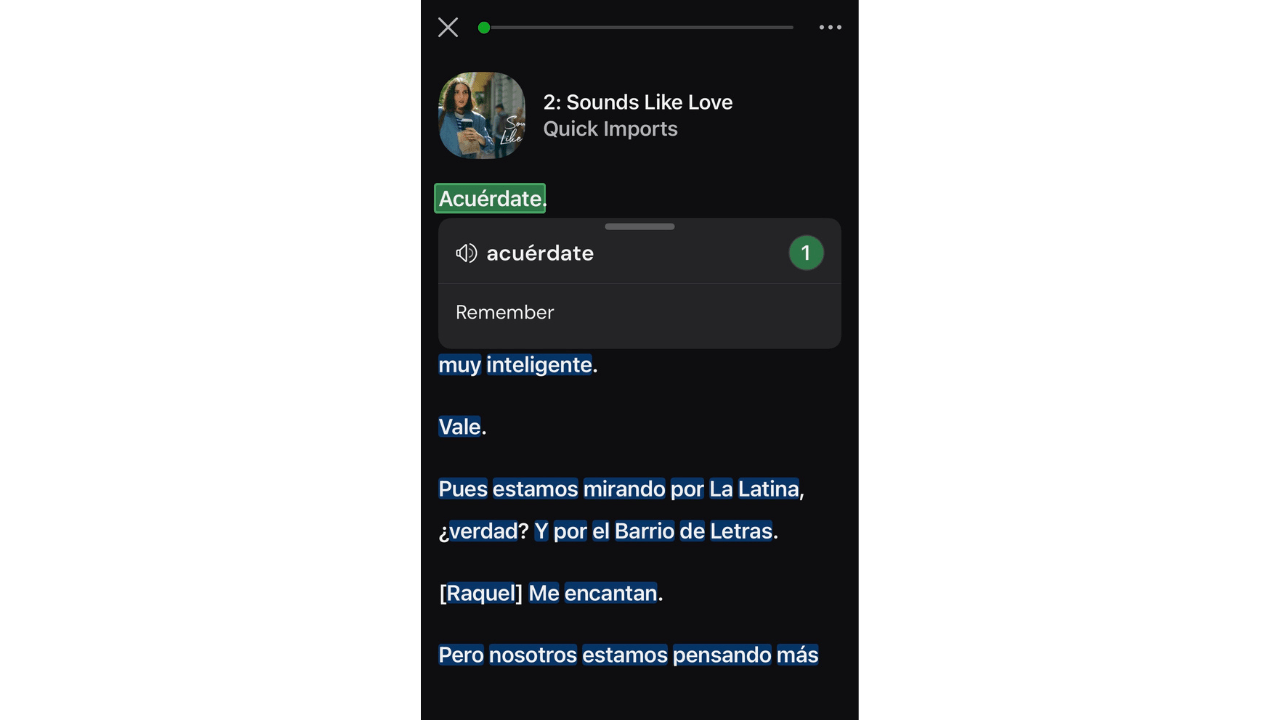
Knowing the rules is one thing. Using them automatically in real conversation is another. The gap between the two closes through repeated exposure to both verbs in real Spanish, not through more memorisation.
This is where LingQ is built differently from most language tools. Instead of drilling verb tables, you read and listen to real Spanish content: articles, podcasts, stories, YouTube videos, Netflix shows. Every time you encounter ser or estar in a natural sentence, your brain registers the context, the speaker, the emotion, the situation. That repeated contextual exposure is what builds instinct.
LingQ’s Spanish library has content at every level from beginner Mini Stories through to advanced native material. When you come across a form of ser or estar you’re unsure about, you tap it, see the translation in context, and save it. Over time you’ll notice you’re no longer thinking about which verb to use. You’re just using the right one.

Start learning Spanish on LingQ for free and see ser and estar the way native speakers actually use them.
If you’re still building your overall Spanish foundation, Steve’s guide to the best way to learn Spanish covers the method behind the approach.
FAQ: Ser vs Estar
Both mean “to be,” but they serve different roles. Ser is for who or what something is (origin, occupation, personality). Estar is for how or where something is (emotions, health, location).
Use estar when describing a temporary state, condition, location, or ongoing action — anything that could change. The PLACE acronym covers the five main cases: Position, Location, Action, Condition, Emotion.
– Position: Está sentado. (He is sitting.)
– Location: Estamos en Madrid. (We are in Madrid.)
– Action: Estoy comiendo. (I am eating.)
– Condition: Está enfermo. (He is sick.)
– Emotion: Estoy feliz. (I am happy.)
Use ser when describing something fundamental to the identity of a person or thing — origin, character, relationships, occupation, and time. The DOCTOR acronym covers the six main cases: Description, Occupation, Characteristic, Time, Origin, Relationships.
– Description: Es alta. (She is tall.)
– Occupation: Soy médico. (I am a doctor.)
– Characteristic: Es generoso. (He is generous.)
– Time: Hoy es martes. (Today is Tuesday.)
– Origin: Somos de España. (We are from Spain.)
– Relationships: Es mi hermana. (She is my sister.)
When in doubt, ask yourself: is this a permanent, defining quality (ser) or a current state that could change (estar)?
This is a helpful shortcut, but it isn’t a perfect rule. For example, location always uses estar even if a building is permanent (El banco está aquí). Likewise, an event’s location always uses ser.
These are the gold standard for remembering the rules. Use ser for DOCTOR: Description, Occupation, Characteristic, Time, Origin, and Relationship. Use estar for PLACE: Position, Location, Action, Condition, and Emotion.
Yes, and this often changes the meaning. Es aburrido means he is a boring person (identity), while está aburrido means he is bored right now (state). Similarly, es malo means he is a bad person, but está malo means he is currently sick.
Both verbs are irregular in the present tense. Ser conjugates as: soy, eres, es, somos, sois, son. Estar conjugates as: estoy, estás, está, estamos, estáis, están.
The nosotros form is somos (we are). For example, Somos estudiantes (We are students).
Choosing the wrong verb changes your message. Calling someone “Eres linda” praises their inherent beauty, while “Estás linda” refers only to how they look right now. Understanding this distinction helps you avoid misunderstandings and sound more natural.
At its core, estar describes a state of being or a location. In other words, it answers the questions “How are you?” or “Where are you?” rather than “Who are you?” It is also the verb used to describe actions happening right now, such as Estoy comiendo (I am eating).
The most effective way is through massive amounts of reading and listening. Seeing these verbs in context, across different stories and conversations, builds a natural instinct that grammar drills can’t provide.
In Summary:
Ser and estar are not just a grammar rule to memorise. They reflect a genuinely different way of thinking about states and identity. Once you have enough exposure to real Spanish, the right choice starts to feel obvious before you’ve consciously applied the rule. That’s the goal: not rule-recall, but instinct.
Start Learning Spanish on LingQ
Looking for proof that LingQ works? An independent study ranked LingQ #1 for language learning outcomes.
***
Adriana Rodrigues is a Peruvian-American who has had experience playing professional soccer and working while speaking Spanish In addition to Spanish, she knows German, Portuguese, and English.
You might also like